
Taking a regenerative grazing operation to the next level
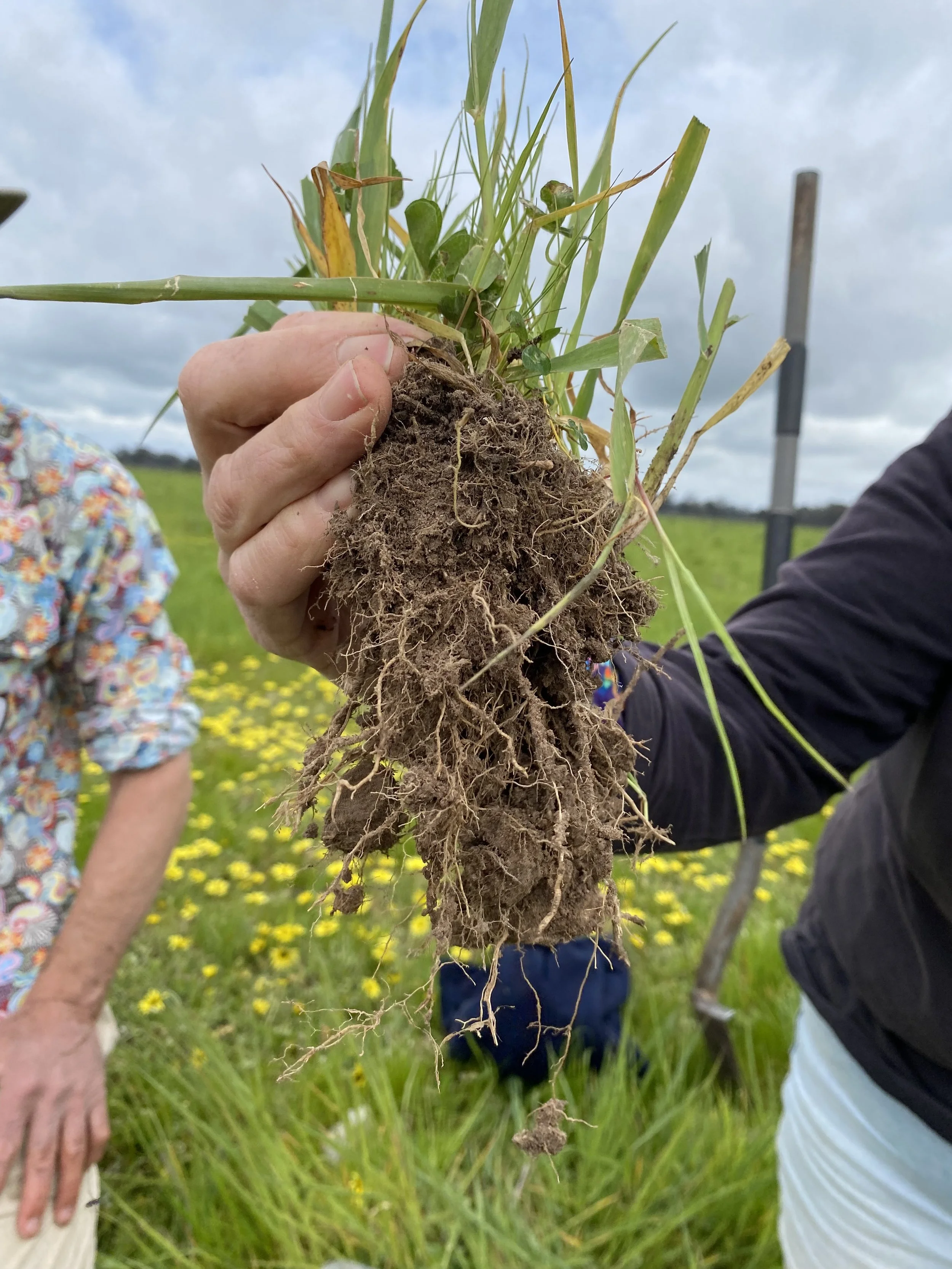
Five years into holistic planned grazing, this client’s groundcover management was excellent, their sheep were calm and healthy, and their organic matter levels were solid. The farm was clearly being looked after. But the goals, increasing stocking rate, improving profitability, shifting from price takers to price makers, required more than good grazing. The soil and their marketing plan needed attention.
What we found
In spring 2025, Courtney conducted soil and plant testing across three paddocks on this 390-hectare property near Nagambie, central Victoria. The picture was more complex than the surface suggested.
Two of the three paddocks tested as sodic, with Exchangeable Sodium Percentages above 6%, meaning clay particles were dispersing in water rather than holding together. The practical consequences were visible: surface crusting, poor water infiltration, compaction, and shallow rooting depths despite years of careful grazing management. Soil pH was acidic in the sandier paddocks, with one sitting at 5.21, creating conditions where aluminium becomes toxic to plant roots and phosphorus gets locked up and unavailable.
Mineral testing revealed widespread deficiencies across all paddocks: calcium, phosphorus, copper, zinc, boron, and cobalt, alongside high iron levels. Plant tissue testing of phalaris confirmed these deficiencies were translating through to the feed, with calcium deficiency in two of the three tested paddocks. Phalaris itself had become dominant in several areas, crowding out diversity despite the client's best efforts to manage for it.
The microbiology reflected all of this. Very few worms or soil organisms were found in the field. Aggregate stability tests suggested limited biological activity, and the presence of weed species (flatweed, capeweed, sorrel, capeweed) pointed consistently to low calcium and bacterially dominant, compacted soils.
The one bright spot was a central paddock which was the most biologically active of the three. It also had the best mineral balance and the best pasture health and diversity. Not coincidentally, we also observed a greater presence of birdlife in this area.
The approach
The key insight from this assessment was that grazing alone, however well executed, couldn't overcome the chemical constraints in the soil to the level that they needed. Sodicity and acidity were the primary limiting factors, and until those were addressed, multispecies pastures wouldn't establish well, legumes wouldn't persist, and the soil biology needed to drive nutrient cycling wouldn't thrive.
Courtney structured the action plan around a clear sequence: fix the soil chemistry first, then build diversity, then refine. The three immediate priorities were trialling gypsum on sodic paddocks to displace sodium and improve structure, applying lime to the most acidic paddock, and establishing diverse multispecies pastures once the soil conditions could support them.
Alongside this, the plan addressed livestock health through targeted mineral supplementation, a gradual reduction in routine anthelmintic use in favour of monitoring-based targeted treatment, and a longer-term shift toward multispecies pastures including chicory and plantain, both of which have demonstrated benefits for parasite management in sheep.
The report also included a dedicated section on marketing, reflecting the client's goal to move away from commodity pricing. The recommendation was to start with a clear farm brand and story, build a simple website, and focus on building relationships and personal profile to grow sales opportunities.
Where things stand
This is a farm with genuinely strong foundations and motivated managers who are already thinking in systems. The work ahead is about addressing the chemical constraints that five years of good grazing couldn't fix on their own, and then letting the biology follow. The potential, once sodicity and acidity are addressed and diversity is established, is significant.